
Every once in a while, I have the good fortune to see the same—or almost the same—exhibit in two cities. It’s always fascinating to notice how differently curators in different parts of the world interpret the same artist.
That’s exactly what happened with Gustave Caillebotte: The Painter’s Eye at the Musée d’Orsay in Paris, which closed in January 2025. The ongoing Gustave Caillebotte: Painting His World at the Art Institute of Chicago runs from June 29 to October 5, 2025. Both celebrate one of Impressionism’s most intriguing figures—but each tells a different story.

Paris: “Painting Men” — Masculinity and Modernity
The Musée d’Orsay exhibition focused on Caillebotte’s depictions of men: his brothers, friends, workers, sportsmen, and male leisure figures. It examined masculinity in late 19th-century France and highlighted how Caillebotte often painted men in intimate or domestic spaces typically reserved for female subjects.
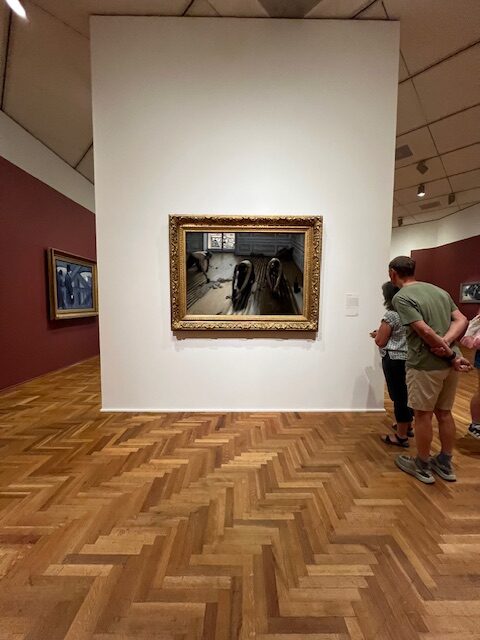
The Paris exhibition positioned Caillebotte as both observer and innovator. It demonstrated how his choice of subjects reflected social change. His works highlighted modern life. Iconic works like The Floor Scrapers and Paris Street; Rainy Day became lenses for exploring male identity, labor, and leisure.
Chicago: “Painting His World” — Relationships, Life, and Social Circles
The Art Institute of Chicago’s Painting His World is happening right now, and it’s a different, more immersive experience. This exhibition presents over 120 works—paintings, drawings, photographs, and personal artifacts—and looks at Caillebotte’s personal relationships and social world.
Here, the emphasis isn’t exclusively on male figures but on the people and environments that shaped Caillebotte’s life: friends, family, colleagues, and social circles. The show combines art and artifacts to give a richer sense of the artist as a person, showing how his social context influenced his creative vision.
In Chicago, the same works that were in Paris take on a new dimension: The Floor Scrapers isn’t just a study of men at work—it’s part of a larger narrative about the world Caillebotte lived in, from his friendships to his leisure activities and everyday life.
My Take (with a Little Hometown Pride)
Both exhibitions offer rich insight into Caillebotte’s life and work. But maybe I’m a little biased—or just too proud of my hometown—but I have to admit, I preferred Chicago’s representation. There’s something warmer, more accessible, more layered about the way it approaches the artist. Where Paris felt refined and focused, Chicago feels broader and more personal.
Congratulations to Gloria Groom—our wonderful curator and Chicago treasure!
Hint: Léa French Café at 20 N. Michigan Avenue is a great spot for breakfast or lunch, before or after touring the museum.



Leave a Reply