
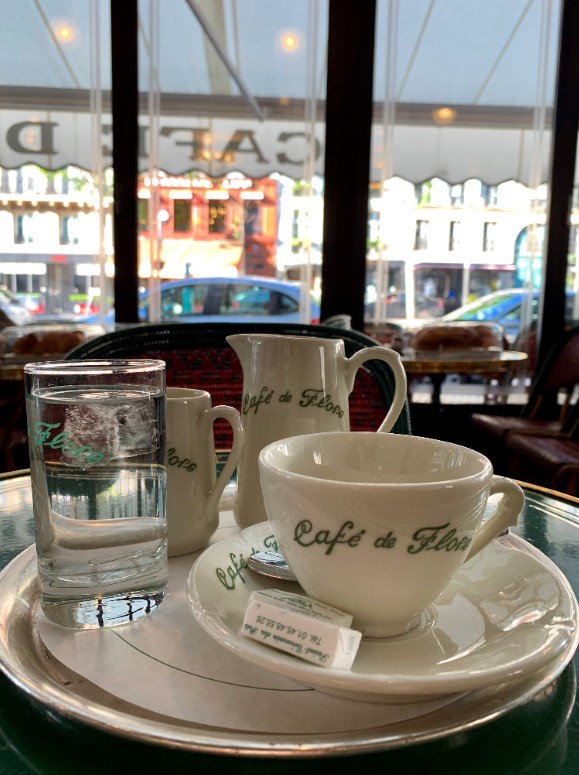
I once assumed that the variety of coffee drinks in France came down purely to personal taste: if you like milk or cream, order a café crème; if you don’t, order an espresso. Simple enough—n’est-ce pas?
Not quite. Like many everyday French customs, coffee culture follows an unspoken logic rooted in balance, digestion, and what best complements the moment. In France, what you order often reflects not just taste, but an intuitive understanding of how food and drink work together—especially at different times of day.
Coffee here isn’t fuel. It’s a ritual.
Rather than grabbing a disposable paper cup with a plastic lid and walking through the city, the French embrace la pause café—a small but meaningful break in the day. Whether seated at a terrace table or standing at the bar, this petite pause is about slowing down, observing the street, exchanging a few words with the barista, and savoring the moment. Even a quick espresso is taken with intention, served in a porcelain cup, meant to be enjoyed—not rushed.
Once you understand this rhythm—and the reasoning behind it—ordering coffee in France feels far less mysterious and far more pleasurable.
A Guide to French Café Drinks
Café Crème (or une crème) │ An espresso topped with steamed milk, similar to a small latte. It’s most commonly ordered in the morning and often enjoyed with a croissant. Milk softens the intensity of espresso and is traditionally thought to be gentler on an empty, more acidic stomach—one reason milk-based coffees are associated with breakfast rather than later in the day.
Café au lait │ Coffee with hot milk, traditionally made with brewed (not espresso) coffee and served in a large cup—or even a bowl—at home. Like the café crème, it’s closely tied to the morning meal and breakfast routine. It’s far more common at the breakfast table than ordered at a café in the afternoon.
Un café (or un espresso) │ A single shot of espresso, strong and concentrated. In France, this is the default coffee order. It’s typically enjoyed after a meal, when food has already buffered the stomach, or on its own in the afternoon. Even then, it’s never rushed—often taken standing at the bar, but always with intention.
Un déca │ A decaffeinated espresso, ordered just like a regular café. It’s most often enjoyed after a meal or later in the day.
Un noisette │ Noisette means hazelnut, referring here to the color rather than the flavor. It’s an espresso with just a touch of milk—enough to soften the coffee without turning it into a milk-based drink. A French friend once told me, “If you can’t quite face an espresso in the afternoon, order a noisette instead of a café crème—it’s much more chic.”
Special note: You might see un noisette written as une noisette, which can be confusing since noisette is feminine. But un noisette is actually correct—it’s short for un café noisette.
- Une noisette = the nut itself
- Un noisette = un café noisette
French café goers love their little linguistic shortcuts—once you know them, ordering feels like joining an insider club.
Un café allongé (or un café Américain) │ As you may have guessed, un allongé is a big cup of black coffee and most like the filtered coffee Americans typically drink. Essentially, it’s a espresso with hot water added to it. The strength of an allongé varies with the number of shots of espresso and the amount of water added.
What to Keep in Mind
Milk-heavy coffees are rarely ordered after lunch. A café crème or café au lait later in the day isn’t forbidden—but it does go against the French instinct for what complements digestion. When in doubt, un café, un déca, or une noisette will always feel right.
Ultimately, enjoying coffee in France is less about choosing the “right” drink and more about embracing the moment. Find a corner at a café, watch the city unfold, and let the cup in your hand mark a true pause in your day.


There’s no recipe link for your quiche dough/pastry.😢
Hi Karen, Thanks for pointing this out to me. I just now updated the post to include the pastry dough recipe in the post. Previously, one had to follow the link to the recipe. But, it makes sense to include both recipes within the same post – so, again, thank you! Jeannine https://jeanninebergeron.com/2009/05/lart-de-la-cuisine-quiche-lorraine/